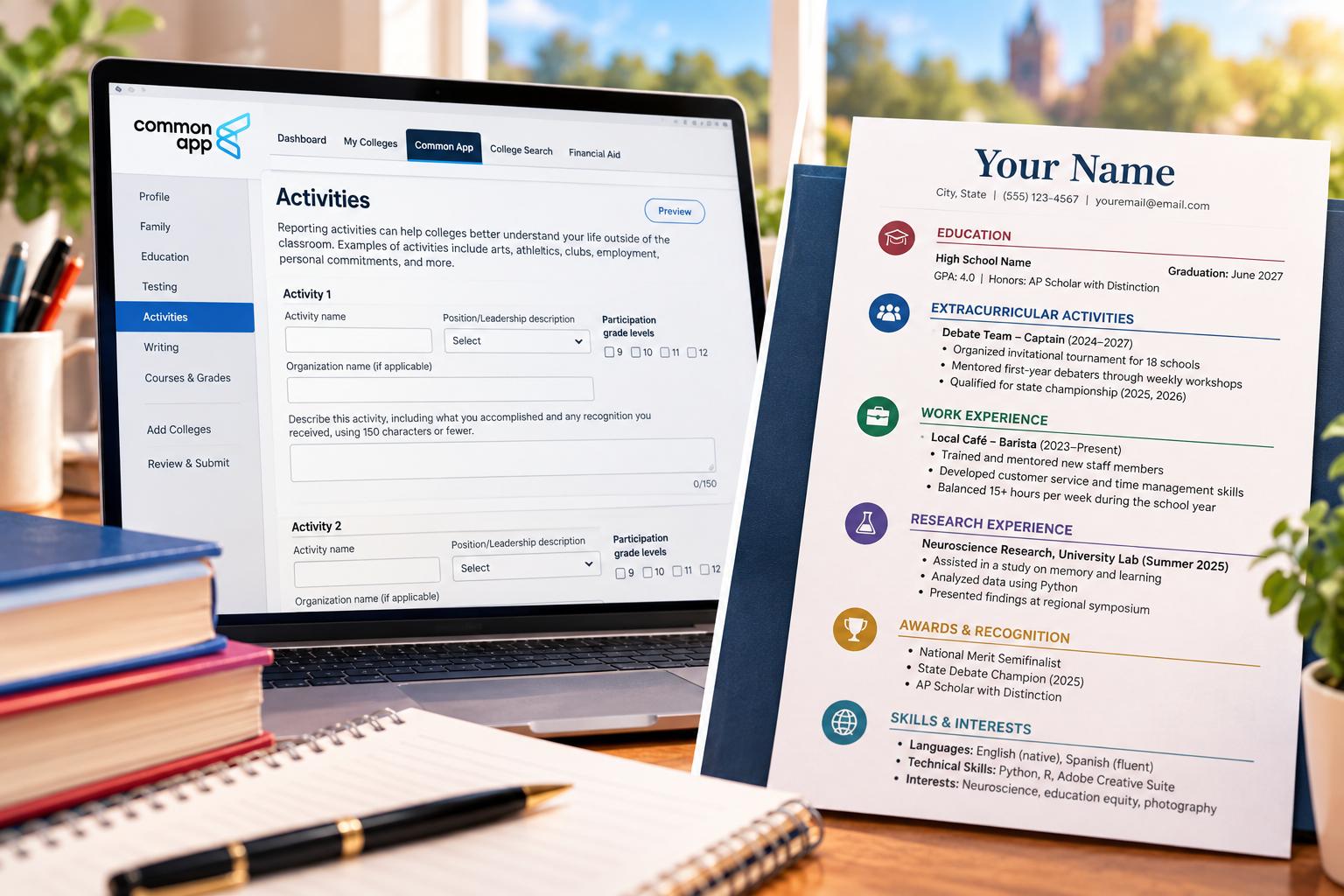
Activities Section vs. Résumé
By
AtomicMind Staff
September 30, 2026
•
3
min read
Share this Article
Simply highlight text to share on social or email
Many students assume that the Activities section on the Common Application and a résumé are essentially the same thing. After all, both list your extracurricular activities, leadership positions, work experience, and achievements.
So why would you need both?
The answer is that they serve very different purposes. Think of the Activities section as a carefully curated highlight reel. Your résumé, on the other hand, is a much more complete record of your experiences and accomplishments. Understanding the distinction and knowing when a résumé actually adds value can help you present a stronger, more coherent application.
Start with the Activities Section
For most colleges, the Activities section is your primary opportunity to showcase how you've spent your time outside the classroom. On the Common Application, you can list up to 10 activities, along with a brief description, your role, and your weekly time commitment.
The space is intentionally limited. Colleges aren't asking you to document everything you've ever done. Instead, they're asking you to identify the experiences that have been most meaningful and to communicate their significance concisely. That's why your Activities section should be selective.
Every activity should earn its place.
A Résumé Tells a Bigger Story
A résumé isn't limited to ten entries or 150-character descriptions. It allows you to provide additional context about experiences that simply won't fit elsewhere in your application.
For example, your résumé might include:
- internships or employment history;
- research projects;
- publications or presentations;
- certifications or technical skills;
- artistic performances or exhibitions;
- languages spoken;
- significant awards;
- independent projects;
- extensive volunteer work.
Unlike the Activities section, a résumé also allows you to organize experiences into categories that make sense for your profile. For example:
- For a student deeply involved in scientific research, you might have separate sections for Research Experience, Publications, and Presentations.
- For an aspiring musician, your résumé might distinguish between Performances, Leadership, and Teaching Experience.
The goal isn't to make your résumé longer; it's to make it more informative.
Not Every College Wants a Résumé
Here's something many students don't realize:
- Many colleges don't request or even allow résumés.
- Some institutions provide an optional upload.
- Others prefer applicants to rely exclusively on the Common Application.
Always check each college's admissions website before assuming you should submit one.
If a résumé is optional, ask yourself an important question: Will it add meaningful information that isn't already in my application? If the answer is no, you probably don't need it.
Your Activities Section Should Be Curated
One of the biggest mistakes students make is trying to squeeze their entire résumé into the Activities section. The result is usually a long list of disconnected experiences that makes it difficult for admissions officers to understand what really matters to the applicant.
Instead, think strategically. Your Activities section should answer one question: How have I chosen to spend my time? That means emphasizing sustained commitments, leadership, growth, and impact; not simply listing every club you ever joined.
If you've read our guide to building a compelling Activities List, you'll remember that ordering matters, descriptions matter, and coherence matters.
The same principles still apply.
Your Résumé Doesn't Need to Repeat Everything
A résumé should complement your application, not duplicate it.
For example, suppose your Activities section includes: Debate Team — Captain
Your résumé doesn't need another bullet saying:
• Captain of Debate Team
Instead, it might provide additional information that couldn't fit within the Common App's character limit:
- Organized invitational tournament for 18 schools.
- Mentored first-year debaters through weekly workshops.
- Qualified twice for the state championship.
The résumé expands the story.
It doesn't retell it.
Think About the Application as a Whole
One of the best ways to approach your application is to imagine that every component has a different job.
- Your transcript demonstrates academic performance.
- Your essays reveal your personality and values.
- Recommendation letters provide an outside perspective.
- Your Activities section shows where you've invested your time.
- A résumé (when appropriate) fills in the remaining details.
Admissions officers read your application as a complete package. Each section should contribute something new.
What Belongs Only on a Résumé?
Certain experiences simply don't fit comfortably within the Activities section.
For example:
- A student applying for engineering might include links to a GitHub portfolio or describe several independent coding projects.
- An aspiring journalist may list published articles.
- A violinist could include concerto performances, masterclasses, and summer conservatories.
- A researcher might highlight conference presentations or co-authored publications.
These accomplishments may strengthen an application but don't always fit neatly into one of the ten Common App activity entries. A résumé provides the flexibility to present them clearly.
Keep Your Résumé Focused
Just because a résumé has more space doesn't mean you should use every inch of it.
For most high school students, one page is ideal. Admissions officers review thousands of applications. A concise, well-organized résumé is far more effective than a dense two-page document filled with every award you've received since middle school.
Prioritize relevance over completeness.
Quality still beats quantity.
Should International Students Prepare a Résumé?
In many countries, students are accustomed to preparing academic CVs or résumés.
Even if a particular college doesn't request one, creating a résumé can still be useful.
It gives you:
- a master document of your experiences;
- an easy resource when completing applications;
- helpful material to share with teachers writing recommendation letters;
- a starting point for scholarship applications and interviews.
Think of it as an organizational tool first and an application document second.
Final Thoughts
The Activities section and your résumé aren't competitors; they're teammates. One provides a carefully edited snapshot of your extracurricular life. The other offers additional context when colleges want or allow it. Together, they create a fuller, more compelling picture of who you are and what you'll bring to a college community.
The strongest applications use each document intentionally.
Need Help Perfecting Your Activities List and/or Résumé?
At AtomicMind, we help students think beyond individual application components and build a cohesive admissions strategy. From prioritizing Activities List entries to crafting professional résumés that complement rather than duplicate the rest of an application, our advisors ensure that every piece of your application tells part of the same authentic story.

Share this Article