
What Are the Biggest College Admissions Trends in 2026?
By
AtomicMind Staff
September 1, 2026
•
3
min read
Share this Article
Simply highlight text to share on social or email
Every year, the Common Application publishes a comprehensive report analyzing admissions trends across its member colleges. The latest report, covering the 2025–2026 application cycle, spans nearly 50 pages of data on applicant demographics, application behavior, standardized testing, and institutional trends.
For students and families preparing for the 2026–2027 admissions cycle, the report offers valuable insights into how the landscape continues to evolve.
The headline? College admissions are still becoming more competitive, but perhaps not in the ways most people expect.
Rather than focusing on a single statistic, here's what you really need to know.
Students Are Applying to More Colleges Than Ever
One of the clearest trends is that students continue to cast increasingly wide nets.
This year, 1,527,328 students submitted 10,786,782 applications through the Common App. While the number of applicants increased by just 2%, the total number of applications grew by 6%, meaning students submitted more applications per person than ever before. The average applicant applied to 7.06 colleges, up from 6.79 the previous year.
This helps explain why admissions often feel increasingly unpredictable.
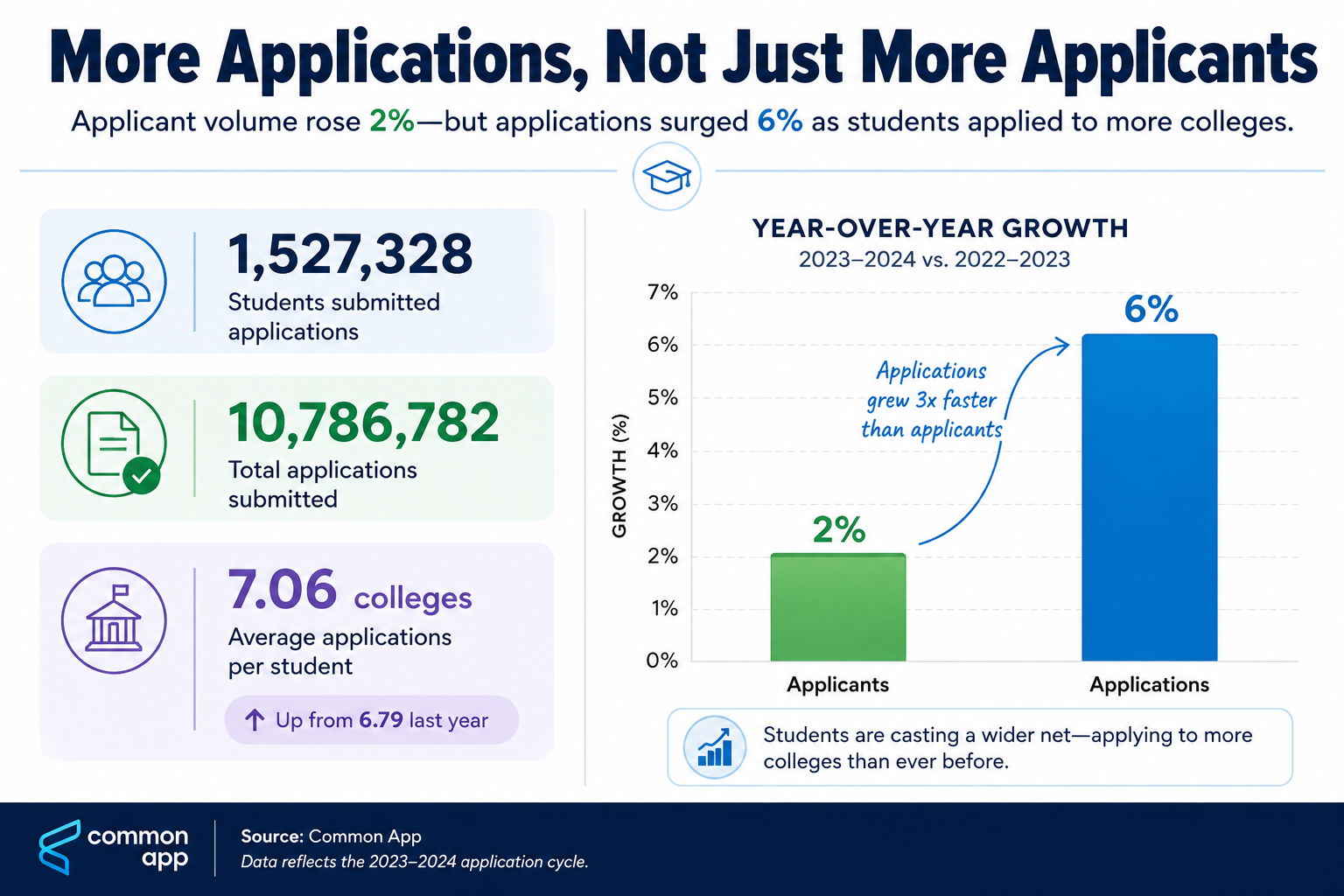
You're no longer competing against just more students; you're competing against more applications from each student. Colleges must sort through an ever-growing number of applications, making it harder to predict outcomes even for highly qualified candidates.
The takeaway isn't that you should submit twenty applications. Instead, it's a reminder that building a thoughtful, balanced college list matters more than ever.
College Access Continues to Expand
One of the most encouraging findings in this year's report is that more students from historically underrepresented backgrounds are applying to college.
Compared to last year:
- First-generation applicants increased by 6%
- Applicants from below-median-income ZIP codes increased by 8%
- Applicants eligible for Common App fee waivers also grew by 6%
These trends suggest that financial aid initiatives, outreach programs, and expanded college access efforts continue to bring more students into the admissions process.
For applicants, this means admissions offices are evaluating increasingly diverse classes with a wide range of life experiences, educational opportunities, and personal stories.
Strong academics remain essential, but context has never been more important.
International Applications Took an Unexpected Turn
Perhaps the most surprising statistic in the report concerns international applicants.
After years of steady growth, the number of international applicants declined by 10%.
The largest decreases came from:
- Asia (-11%)
- Africa (-17%)
- India (-15%)
- Ghana (-34%)
The report deliberately does not speculate about the reasons behind this shift, and it's important not to overinterpret a single admissions cycle. However, many observers have noted that recent visa uncertainty, geopolitical tensions, changing economic conditions, and concerns about studying in the United States may all be influencing student decision-making.
For domestic applicants, this does not necessarily mean admissions have become easier. International students make up only one portion of the overall applicant pool.
For international families, however, it's a reminder that admissions trends can shift quickly, making it especially important to build a balanced college list.
Standardized Test Scores Are Making a Comeback
Over the past several years, test-optional admissions transformed how students approached the SAT and ACT.
This year's data suggests another shift may be underway.
Applicants who submitted standardized test scores increased by 11%, while applicants choosing not to submit scores declined by 5%. For the first time since the pandemic, more Common App applicants submitted test scores than withheld them.
Importantly, this does not mean that test-optional policies are disappearing. In fact, only about 5% of Common App member institutions required standardized test scores during the 2025–2026 cycle.
Instead, students increasingly appear to believe that strong scores strengthen an already competitive application.
If your SAT or ACT score falls comfortably within or above a college's middle 50% range, submitting it can still provide an advantage at many institutions.
Public Universities Continue to Gain Momentum
Another noteworthy trend is the growing popularity of public universities.
Applications to public institutions increased by 7%, compared with 5% growth for private colleges.
This reflects a broader shift that has been building for years.
Many flagship public universities now offer world-class honors colleges, extensive undergraduate research opportunities, strong career outcomes, and exceptional value, particularly for in-state students.
Increasingly, families are viewing these universities not as "backup options," but as first-choice destinations in their own right.
The Most Selective Colleges Aren't Driving Application Growth
Many families assume that every admissions cycle is defined by skyrocketing applications to Ivy League schools and other ultra-selective institutions.
This year's report paints a more nuanced picture.
Applications to colleges admitting fewer than 25% of applicants grew by only 3%, while institutions with higher acceptance rates experienced stronger growth.
This doesn't mean highly selective colleges are becoming easier to get into; rather, it suggests students are building broader, more balanced college lists instead of concentrating almost exclusively on the most selective institutions.
That's exactly the approach admissions experts have encouraged for years.
The Biggest Story Isn't One Statistic, It's the Changing Applicant Pool
Stepping back from the individual charts, perhaps the most important takeaway is that the college applicant pool continues to evolve.
Today's applicants are more diverse economically, geographically, and educationally than ever before. Students from rural communities are applying in greater numbers. First-generation applicants continue to grow. Public universities are attracting increased interest. Testing patterns are changing yet again.
There is no longer a single "typical" successful applicant.
That makes authenticity even more valuable.
Admissions officers aren't looking for students who all followed the same checklist—they're building communities of students with different strengths, experiences, and perspectives.
What This Means for Students Applying This Year
If you're preparing applications for the 2026–2027 admissions cycle, resist the temptation to chase trends. Instead:
- Build a balanced college list based on academic fit—not rankings alone.
- Focus on developing a compelling personal narrative rather than trying to appear "perfect."
- Submit standardized test scores strategically, not automatically.
- Remember that context matters. Admissions officers evaluate achievement relative to opportunity.
- Prioritize quality over quantity when completing applications.
The students who will stand out aren't necessarily those with the longest résumés or the highest number of applications.
They're the students who present a thoughtful, authentic application that clearly communicates who they are, what they value, and how they'll contribute to a college community.
Final Thoughts
Every admissions cycle produces headlines about acceptance rates, testing policies, or application records.
The 2025–2026 Common App report tells a more interesting story.
College admissions continue to evolve, not because there's a single new rule, but because the applicant pool itself is changing. Success today depends less on following a formula and more on understanding where you fit, telling your story well, and applying strategically.
Need Help Understanding The Impact on You?
At AtomicMind, we help students interpret admissions trends and translate them into personalized application strategies. Whether you're building your college list, deciding whether to submit SAT or ACT scores, or crafting essays that reflect your authentic voice, our advisors are here to help you navigate the process with confidence.

Share this Article