2026 John Locke Global Essay Competition
By
AtomicMind Staff
February 25, 2026
•
10
min read
Share this Article
Simply highlight text to share on social or email
The Competition Overview: Why is the John Locke Global Essay Prize Important?
The 2026 John Locke Global Essay Prize continues to stand out as one of the most prestigious academic competitions for high school writers worldwide: free to enter, rigorously judged, and globally recognize for deep critical thinking. Registration is open now and students are already planning responses that showcase clarity, originality, and real argumentative depth.
This competition is an opportunity for young, creative minds with complex ideas, boundless ambitions, and a love of writing. For many, this is a first step into philosophical debate, allowing students to hone their argumentative essay skills with challenging, often open-ended, thought-provoking prompts in several categories.
Understanding Essay Prompts and Past Essay Analysis
The John Locke Global Essay Competition is all about tackling some of the most thought-provoking questions around human understanding across a range of subjects.
2026 Essay Prompts
The Global Essay Prize 2026 expands its academic scope with three new subject areas alongside classics like philosophy and economics. Students now choose from 10 categories, each with their own set of provocatively framed questions to spur diverse intellectual engagement.
Economics Category
- Q1. Should we fear a cashless society?
- Q2. Technology now allows personalised pricing. If this came to be widely used, what effects should we expect?
- Q3. Did Jeff Bezos get rich at the expense of his customers, his employees, neither or both?
History Category
- Q1. 'The arc of the moral universe is long, but it bends toward justice.' Is it? Does it?
- Q2. What might the world look like if the Library of Alexandria hadn’t burned down?
- Q3. Does Che deserve his iconic T-shirt?
International Relations Category
- Q1. Does foreign aid help or hurt poor people?
- Q2. Is the US economy harmed by cheap imports from China?
- Q3. Should a coalition of countries (or of billionaires) run an experiment with a libertarian microstate?
Law Category
- Q1. If legislators and judges all accepted the philosophical theory of determinism, what would be the effect on criminal sentencing?
- Q2. To what extent should criminal sentencing take into account the effect on the perpetrator’s family?
- Q3. Is trial by jury obsolete?
Philosophy Category
- Q1. Is it ever wrong to do the right thing for the wrong reasons?
- Q2. What consolations does philosophy offer?
- Q3. Why is incest wrong?
Politics Category
- Q1. Is the right to self-determination absolute?
- Q2. Did the pandemic normalise authoritarianism?
- Q3. Is democracy in crisis?
Psychology Category
- Q1. Why do we care what happens to our body after death?
- Q2. Is mental illness over-diagnosed now, or just better recognised?
- Q3. Surveys show a widening gender ideological gap in recent years. Why?
Public Policy Category
- Q1. What discount rate should be applied to long-run environmental policies? Why?
- Q2. Which unintended consequence was most devastating and why did we fail to predict it?
- Q3. Should vaccination be mandatory in a public health emergency?
Science and Technology Category
- Q1. Is free speech the enemy of science?
- Q2. Is space exploration a necessity or an indulgence?
- Q3. Should we be polite to ChatGPT?
Theology Category
- Q1. Is religious experience better explained by neuroscience or by theology?
- Q2. Research shows a strong inverse correlation between religiosity and per-capita spending on education. Does one cause the other?
- Q3. If you achieve enlightenment, how will you know?
Tips for Tackling These Prompts
1) Deconstruct the prompt before you write a single paragraph.
Many 2026 questions are built around loaded words (“fear,” “crisis,” "obsolete," “authoritarianism,” “enemy of science”). Start by rewriting the question in neutral terms and identifying what it’s really asking. Then list:
- what counts as “harm,” “help,” “justice,” or “necessity,”
- what time horizon you’re using (short-run vs long-run), and
- what baseline you’re comparing against (e.g., “cashless” compared to what, exactly?).
2) Define your key terms like you’re writing for a skeptical judge.
The strongest essays won’t just “have an opinion,” but they’ll control the definitions. In 2026, that’s non-negotiable for prompts like:
- “free speech,” “science,” and “enemy”
- “mental illness” and “over-diagnosed”
- “self-determination” and “absolute”
- “foreign aid” and “poor people”
A clean definition section early on prevents your essay from drifting into vague moralizing.
3) Choose a clear analytic lens and stick to it.
These prompts reward structure. Pick the best tool for the question and commit:
- Economics/Public Policy: incentives, externalities, distributional effects, welfare tradeoffs, discounting, market power
- Politics/IR: legitimacy, sovereignty, institutional constraints, strategic incentives, unintended consequences
- Psychology: mechanisms + evidence quality (what would change your mind?)
- Philosophy/Theology: ethical frameworks, conceptual clarity, objections and replies
Judges don’t need name-dropping. They need a framework that drives reasoning.
4) Anticipate the strongest objection, then address it head-on.
The 2026 prompts practically demand counterarguments (Bezos/wealth, vaccines/mandates, juries/obsolete, China imports/harm). Build at least one section that starts:
- “A strong objection is…”
- “This argument fails if…”
- “The best case for the other side is…”
Then respond with evidence or a sharper distinction, not vibes.
5) Use examples strategically: one strong case beats five shallow ones.
Several 2026 questions are empirical or historical. Don’t scatter. Pick one or two high-leverage examples and go deep: mechanism → evidence → implications. If you’re doing counterfactual history (Alexandria), explicitly state what assumptions you’re making and what would falsify them.
6) Bring originality through insight, not shock value.
Some prompts invite edgy takes (incest, Che, ChatGPT politeness, libertarian microstate). “Hot” isn’t the same as “smart.” Originality here means:
- a distinction others miss,
- a surprising but defensible implication, or
- a well-chosen model applied to a new domain.
Your goal is a judge thinking: this student actually clarified something for me.
Categories and Age Groups
The 2026 John Locke Global Essay Competition features 10 subject categories, each with three prompts. Students may choose any one question from any category.
- Philosophy: Explore foundational questions about morality, meaning, reason, and human behavior. This year’s prompts examine moral motivation, consolation, and ethical taboos — requiring conceptual precision and careful argumentation.
- Politics: Analyze power, governance, democracy, and political legitimacy. The 2026 questions probe self-determination, authoritarian drift, and whether democracy itself is under strain.
- Economics: Examine incentives, markets, inequality, and technological change. Prompts this year explore personalised pricing, wealth creation, and the implications of a cashless society.
- History: Engage with counterfactual reasoning and moral judgment across time. From the arc of justice to the fate of the Library of Alexandria, historical imagination must be paired with disciplined analysis.
- Law: Debate justice, punishment, and institutional design. Questions this year address determinism and sentencing, jury trials, and the broader purpose of criminal law.
- Psychology: Investigate cognition, identity, ideology, and mental health. The 2026 prompts examine post-mortem concern, diagnostic trends, and shifting ideological divides.
- Theology: Consider faith, enlightenment, neuroscience, and religious experience. Essays must balance philosophical clarity with intellectual humility.
- International Relations (New Category): Analyze global trade, foreign aid, geopolitical power, and experimental governance. Students must weigh empirical evidence against normative political theory.
- Public Policy (New Category): Apply economic reasoning and ethical trade-offs to real-world decision-making. This year’s questions focus on environmental discounting, unintended consequences, and vaccination mandates.
- Science & Technology (New Category): Examine the relationship between innovation, knowledge, speech, and ethics. Prompts explore whether free speech conflicts with science, the value of space exploration, and even whether we owe politeness to artificial intelligence.
Each essay must be argumentative and under 2,000 words, excluding bibliography and/or end notes. The word count includes in-text citations, which should be written in APA format.
There are two age groups:
- Senior Division: Ages 14–18
- Junior Division: Age 14 and under
Junior entrants may select from the full list of prompts. Essays are judged separately by age group.
Submission Requirements
To enter the 2026 John Locke Global Essay Competition, students must carefully follow the official submission guidelines. Failure to comply can result in disqualification, even if the essay itself is strong.
File Format
- Essays must be submitted in PDF format.
- The filename must follow this exact structure: FirstName-LastName-Category-QuestionNumber.pdf
For example: John-Doe-Psychology-2.pdf
This standardized naming system allows judges to efficiently organize and review thousands of submissions across all 10 categories.
Academic Reference Requirement
All entrants must provide the email address of an academic referee — typically a teacher or responsible adult familiar with the student’s academic work.
After submission, competition organizers may contact the referee to verify that:
- The essay is the student’s original work
- The student meets eligibility requirements
Students should notify their referee in advance to ensure responsiveness.
The Application Process
Application Steps
The application process begins with registration to showcase the intent to enter. Choose a prompt that resonates with your strong opinions and writing abilities, then do your research, writing, revisions, and polishing before submission.
Important Deadline Information and Requirements
Registration typically opens two months before the submission deadline. Applicants must register within the registration timeline to be able to submit an essay. Those who have not registered by the deadline cannot compete. To help you stay on top of things and plan properly, here are the important dates you’ll need to keep in mind:
- Registration opens: 2 February, 2026.
- Registration deadline: 31 March, 2026. (Registration is required by this date for subsequent submission).
- Submissions open: 1 April, 2026.
- Submission deadline: 31 May, 2026
- Late entry deadline: 7 June, 2026 (for the seven-day extension) or 21 June, 2026 (for the twenty-one-day extension).
- Notification of short-listed essayists: 7 July, 2026.
- Academic conference: 2-4 October, 2026.
- Awards dinner: 3 October, 2026.
Are There Entry Fees?
The John Locke Global Essay Competition remains free to enter.
However, if you miss the primary submission deadline, late extensions require payment of a fee. Payment must typically be made within 24 hours of the original deadline to secure the extension.
Award Levels
In 2025, The John Locke Global Essay Competition drew over 60,000 registrants across all categories.
The Shortlist
These essays stood out to the judges as being deemed worthy of recognition. Judges will further assess them for specific awards/accolades.
Commendation / Merit
These essays are deemed noteworthy, demonstrating comprehension and clear, well-supported arguments.
High Commendation / Distinction
These essays are exceptional, demonstrating excellent writing skills and innovative perspectives. Distinction places the essay among the top entries of the John Locke Global Essay Competition.
High High Commendation / High Distinction
These essays are among the best, notable for superior comprehension of the subject matter and concise points in a debate format.
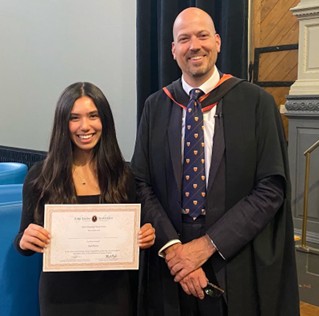
Sample Certificate
Here is an example of the certificates that are sent to winners.
Prizes
Grand Prize, First Prize, Second Prize, Third Prize
Category Winners (First Place) receive a scholarship and are recognized as the best in their chosen field, whether it's philosophy, history, economics, or any other. There are also Second and Third Placements awarded for each category, recognizing strong essays that stood out from the rest. The Category Winners receive recognition while also earning $2000 towards any of the John Locke Institute’s programs.
A Grand Prize winner will be selected from among the first prize winners in each category. Grand Prize winners will be awarded an impressive $10,000 scholarship, which can go towards John Locke Institute summer schools or gap year courses.
John Locke Global Essay Competition Gala
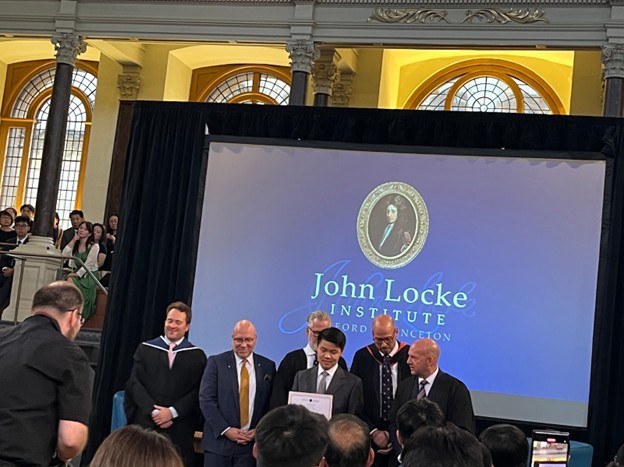
Shortlisted attendees will be invited to the John Locke Global Essay Competition gala, a formal event hosted by the John Locke Institute where the winners of the annual global essay competition are announced and celebrated. The gala typically includes dinner and a ceremony in London, where finalists are invited to attend and receive their awards. It’s considered a prestigious event for young scholars participating in the competition. The 2024 “sneak peek” into the Gala Programme can be found here.
How to Win the John Locke Essay Competition: Tips for Writing a Winning Essay
A competitive essay in 2026 will:
- Present a clear, defensible thesis
- Define key terms early and precisely
- Anticipate and respond to serious objections
- Use evidence strategically rather than superficially
- Maintain conceptual clarity from introduction to conclusion
Strong essays do not simply “have opinions.” They build logical structures.
After drafting:
- Revise for clarity and precision
- Eliminate repetition
- Tighten transitions
- Seek feedback from an academic mentor
Then revise again.
Common Mistakes to Avoid
- Overcomplicating the Argument: Complexity is welcome. Confusion is not. Judges must be able to follow your reasoning.
- Failing to Answer the Actual Question: Many prompts are carefully worded. If the question asks “to what extent,” your answer must reflect degrees — not absolutes.
- Ignoring Counterarguments: Essays that fail to address serious objections rarely advance beyond early review rounds.
- Weak Time Management: Students who start late often submit underdeveloped arguments. Build in time for reflection and revision.
What the Judges Look for at Each Level
The John Locke Global Essay Competition judges care about your ideas and how well you present them through interdisciplinary research and creative prowess. Points should be easy to follow, and you should include counter-arguments to showcase your ability to anticipate and address dissenting viewpoints. Judges look for fresh insights and innovative perspectives, so avoid common or cliche viewpoints.
John Locke Past Sample Essays
The John Locke Institute publishes winning essays/examples of winning essays from each category on their website. We are also including essays from AtomicMind students who have entered the contest and received an award or recognition. Of AtomicMind students who took our 2024 Master Class, 80% received an award or recognition of some kind. Below, you can see some past winning essays across categories:
2025 Economics Category - First Prize: "What kinds of behaviour are engendered by the hope of profit? Is such behaviour better or worse, on balance, than the behaviour we should expect if all enterprises were owned by charities or governments?"
2021 History Category - First Prize: "Should we judge those from the past by the standards of today? How will historians in the future judge us?"
2023 Theology Category - Second Prize: "If you cannot persuade your intelligent, sympathetic friends to embrace your religious belief system, do you have enough reason to believe what you believe?"
2021 Law Category - Second Prize: "Should ‘innocent until proven guilty’ apply not only to courts of law, but also to public censure?"
2023 Psychology Category - Third Prize: "Are beliefs voluntary?"
2021 Junior Category - First Prize: "Should the law ever prevent people from freely making self-harming decisions? If so, what should and shouldn’t be forbidden––and according to which principles?"
FAQS
How much time should I spend preparing for the John Locke Global Essay Competition?
What is your writing process? How fast can you compile an award-winning essay with well-thought-out points on a debate topic? How familiar are you with the content? Preparedness varies depending on an individual’s writing and research capabilities. Think of how long it takes to write a 2,000-word research paper with citations and resources. Then, double the time for brainstorming, drafting, and revising. Your aim should be crafting a well-researched essay worthy of a competitive edge.
Your thoughts should be clear and focused with a flow from beginning to end that engages a reader. You should feel confident about your writing when everything is submitted, so take the time to make it shine. At AtomicMind, we find that students who are shortlisted and win prizes have typically spent between 15 and 40 hours working on their submission.
Can I use quotes from philosophers or scholars?
Yes—you are encouraged to incorporate philosophical and scholarly quotes into your competition essay. Give credit with proper citations, ensure the quotes are relevant to your topic, and only use quotes as supporters for your ideas. How you interpret and analyze the topic with originality and creativity is more critical than the quotes of past philosophers or scholars.
What happens after submitting the essay?
After submission, your essay is reviewed by a panel of readers most of whom have accolades or publications. The best papers are reviewed again, then discarded or forwarded to judges for accolades. Overall, the process takes three months from submission to final evaluation. Shortlisted candidates are notified on or around August 1 and accolades are announced at the awards ceremony that is held at the end of September. Shortlisted candidates who cannot attend the awards ceremony will receive their awards and e-certificates via email.
Can I submit in more than one category?
Yes, you can submit in as many categories as you would like. You only need to register once regardless of how many entries you submit.
Will I receive feedback on my essay?
You will not receive feedback from judges for the John Locke Global Essay Competition. The competition receives thousands of submissions annually, making individual feedback impossible.
How can AtomicMind help you write a Prize or Award-winning essay for the John Locke Global Essay Competition?
You’ve taken the first step with your desire to participate in the John Locke Global Essay Competition! If you are interested in learning more about our John Locke Global Essay Competition Master Class, contact us to be added to our waitlist. You'll be alerted when we schedule our 2026 Master Class, Everything You Need to Know about The John Locke Global Essay Competition.
Through this Master Class, students will benefit from a presentation that analyzes winning essays across various levels of distinction and offers customized guidance to students on creating a winning essay. Our knowledgeable specialists can help you outline, research and craft a well-thought-out, informative, paper with a strong perspective that captures judges’ attention. Bounce ideas off of us, utilize our specialists for feedback and constructive criticism, and let us support your process from participation to success!

Share this Article